Popular Posts

Tuesday, September 27, 2011

Feng Mao

Korean-Chinese restaurants – that is, restaurants serving cuisine of the Chinese immigrants in Korea – such as Hyo Dong Gak have been around New York for decades. I remember eating at one on Manhattan’s W. 32nd St. in the early ‘80’s… I wish I could remember the name of it (their jja jang myun was particularly hearty and comforting, with chunks of potato in addition to the usual ingredients - still perhaps my favorite version ever). But the Chinese-Korean restaurant (by which I mean food of Koreans living in China) is a relatively new phenomenon in New York. They started popping up in Flushing just a year or two ago, and now there are perhaps 5 or 6 of them, plus the stalls in the New World Mall food court. Two of them face each other on 41st Ave.: RiFu has been around a while, and Feng Mao (丰茂飯店 - fēng mào fàn diàn, or, roughly, "luxuriant abundance" restaurant) opened very recently in the space that used to be the late, lamented A Fan Ti. (There is a third just a door or two west of RiFu.)

Yanbian, the Korean autonomous prefecture in Jilin province of northeastern China, is the epicenter of this style of cooking. And it seems that there must be some sort of traditional association in that area with the phrase "fēng mào" (丰茂), as a Chowhound post reveals there is a restaurant in Los Angeles of the same name with proprietors from - you guessed it - Jilin province. It makes perfect sense that there are a lot of Koreans there – it shares a border with North Korea – and their cuisine has obvious characteristics of both countries. With Koreans, you always get banchan, those small dishes that precede and accompany the meal. Last night at Feng Mao, we were given four: salted roasted peanuts, a not-particularly-spicy kimchi of daikon radish shreds and red pepper, thin strips of seaweed with a bit of vinegar and red pepper, and a particularly nice combination of bamboo shoot and jalapeño pepper in a slightly sweet, vinegary sauce. (Photos courtesy of Pete Cuce)


We ordered entirely too much food for four people – six dishes in all (a seventh appeared halfway through the meal, compliments of the house) – and there was hardly an unsuccessful one among them, although the “cold noodles” (冷面 – lěng miàn, which turned out to be naeng myun, or buckwheat noodles in a cold spicy broth) were rather mushy.


Lao gan ma spicy spare ribs” was a winner. Its name in Chinese is rather long –老干妈铁板香辣小排骨 (lǎo gān mā tiě bǎn xiāng là xiǎo pái gǔ) – and presents a bit of a puzzle for the non-native. Tiě bǎn means “iron plate”, and sure enough, it arrives sizzling on an iron plate. Xiǎo pái gǔ means “small spare ribs”, and small they are, hacked into bite-sized pieces. is “spicy”, xiāng, savory or fragrant... so far, so good. But lǎo gān mā? I’ve seen this translated as “old grandma” (although gān means “dry”, implying a shade of meaning I think I’d prefer not to contemplate for too long)... whose dried-up old grandma are these spare ribs named after, anyway? Then I read that Lao Gan Ma is a famous brand of chili paste in China – I’m guessing it’s one of the ingredients. At any rate, the dish is quite tasty, although working around the bone shards can get on ones nerves. (Ed. I've since learned, through the magic of Twitter, that gān mā refers to a sort of adoptive mother figure, rather like a godmother.)


Probably my favorite dish on the table goes by the unassuming name of “sautéed chicken” on the menu, although its Chinese name, nóng fū chǎo jī (农夫炒鸡), means farmer, or peasant, sautéed chicken, making it sound instantly much more like my kind of dish. What arrived was something of a cross between a stew and a stir-fry of small hacked-up pieces of chicken (with bone, so once again, watch out for shards), black mushrooms, green and red bell peppers, and large rounds of potato in a light brown sauce. Delicious, and at 12 bucks, it was the best deal on the table.


The most unusual thing we got was “fried popcorn in egg yolk sauce”(蛋黃玉米粒 – dàn huáng yù mǐ lì). Not quite correctly translated, since the “popcorn” turned out to be just “corn”, but it was still unusual: kernels of corn coated in egg yolk and stir-fried until dry and separate. But not too dry – the corn kernels still retained just enough of their juiciness, and the overall effect was oddly lovely. Definitely worth a try.


The rest of the dishes kept reminding me of others in the area. Their cumin beef (孜然牛肉 – zī rán niú ròu) is quite similar to M & T’s “Qingdao spicy meat”, with a spice combination veering a bit toward that of Fu Run’s muslim lamb chops. Very nice, but at 5 bucks cheaper, I think I’ll head to M & T when I get the craving, even if theirs is pork, not beef. (Click on the photo - the small version below does not do it justice.)


And the “dried tofu with seafood” (八珍豆腐 – bā zhēn dòu fǔ) turned out to be “eight treasure tofu”, just like at Yi Lan (they mean “fried” instead of “dried here). Cubes of fried tofu are covered in a brown sauce with chunks of squid, fish, shrimp, chicken, dried scallops, sea cucmber, and other goodies. Good, but Yi Lan’s is six bucks cheaper for a version that is every bit as good, or better.


The (complimentary on this occasion) rice cakes (打糕 – dá gāo) are just like RiFu’s across the street – dense, gooey chunks served with ground red beans for dipping. The slight sweetness of the red bean makes this dish very dessert-like.


As you’ve no doubt gathered by now, I do find this place rather expensive, especially when you consider what is available nearby. Prices are almost identical at RiFu for food of similar quality, although RiFu’s portions are ENORMOUS (and RiFu has the wonderful “slate tofu” – thick slices of palpably house-made tofu served on a hot stone plate, each with its own dollop of red pepper paste and some minced scallion). But it's a cuisine worth investigating, and if you'd like more information, head over to Joe DiStefano's World's Fare blog and read his piece on Minzhongle.

Feng Mao
136-80 41st Ave., Flushing 11355
718-353-0757

(7 train to Flushing-Main St., walk 2 blocks south on Main, then left on 41st Ave.)

Saturday, September 24, 2011

Savor Fusion (Maple Snacks) (CLOSED)

A couple of weeks ago, I received a tweet from the intrepid Joe DiStefano, of the World’s Fare blog, about a truly great bowl of dàn dàn miàn he had just eaten at a new food court in Flushing. I trust his opinion more than just about any food writer I can think of, so I headed out the next day, in the rain, to find the Savor Fusion food court (although the Chinese characters on the awning – 楓林小吃 – mean “Maple Snacks”). What I found was a nicely-appointed, brand-spanking-new food court with eight stalls that serve some pretty damn good food at fantastic prices. It has become my latest Flushing obsession.

Of course, Joe managed to find it the very first day it was open for business (how on earth does he do it?), which means, I guess, that I was there on its second day. They are still putting on some finishing touches, and the promised English menus have yet to materialize, but it is surprisingly inviting for a Flushing food court, and a 洋鬼子 like me can almost always find a helpful translator when necessary.

Each stall has a placard above the counter with its menu – Chinese only, so far, except for the Shanghai stall – and stall number (somehow two stalls ended up with the designation “#1”, but no matter…). To hit the highlights of my explorations so far: the stall #1 at the very back of the court, away from the doors, is called 水餃 (shuǐ jiǎo, or boiled dumplings) and serves, true to its name, some stellar boiled dumplings. They have some half-dozen varieties that are frozen to take home, or they'll boil up and serve you. The first time I ordered 三鮮 水 (sān xiān shuǐ jiǎo – literally “three fresh”, or three treasure dumplings, the treasures in question being pork, shrimp and chive), I was presented with probably the most perfect dumplings I have ever tasted: the filling was the perfect balance of ingredients, the wrappers just the right consistency, and the two were perfectly wedded together. I subsequently discovered it makes a difference just who boils them up here – of the two guys behind the counter at various times, if there is a choice, try to get to the one with the more prominent, slightly “chiseled” facial features. Neither speak any English, so practice the phrase “sān xiān shuǐ jiǎo”, and for $3.50 you’ll be rewarded with an unbeatable snack.

Next door is #2, hand-pulled noodles. As far as I can tell, their menu is all noodles in soup (the fried noodle thing seems to be show up mostly in southern Chinese cuisines, and these guys are, I think, from the north). They also do knife-shave noodles – 刀削面 (dāo xiāo miàn) – made the real traditional way, shaving the noodles off the top of a block of dough with a cleaver into boiling water (be sure to watch the guy do it), not by using the machine that looks like a hand-held mandoline that I’ve seen in at least one stall in the New World Mall. You might want to ask for these to be cooked more “al dente” – mine had been boiled just a bit too long for my taste, but were otherwise delicious. English is good here, and they are happy to work with you to give you something you’ll like.

Just across the way that leads to the restroom (yes, there is a nice, clean restroom here!) is a Taiwanese stand (#3) called “Fried dumpling” that I haven’t tried yet, but I’m told has excellent má là tāng (麻辣汤, a spicy-tingly noodle soup with a little bit everything in it, plus your choice of meat). Just around the corner is #4, which has no English name, but the Chinese characters are 河南 (HeNan, as in the province). Among other things, they do two kinds of stuffed small steamed pancakes – one being a spicy cumin lamb filling very much like that of Xi’an Famous Foods (and every bit as good, if not better, because their pancakes tend to be fresher), and the other an utterly delicious chopped stewed pork belly filling (ask for 肉夾饃 – ròu jià mó). Their zhá jiang miàn (炸酱面 – noodles with a minced pork and brown bean sauce) is also very good, although next time I will ask them to leave off the bean sprouts.

Continuing to the right is stall #5, called Tian Jin (天津, the city near Beijing). I have not yet investigated this one, and can’t figure out what they do, but almost no item is more than $3.00 (I’m guessing a lot of breakfast items – on mystery Chinese menus, it’s a pretty safe bet that things under $2 are breakfast items). #6 to the right is another stall I haven’t tried with a very short, inexpensive menu that includes two things translated into English: vegetable roll and fried chicken wings. Not quite sufficient to pique my curiosity enough to try it. And all the way to the right, by the Main St. entrance, is the second stall marked #1, purveying Shanghai specialties. A menu placard completely translated into English appeared this week, and it definitely looks worth a try (I haven’t yet, but maybe later today...). Their offerings fall into two categories: almost two dozen prepared (cold) items are available by the pound (a lot of great-looking stuff here), and hot wontons and noodle soups.

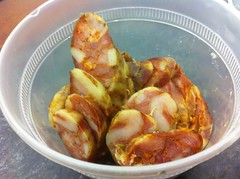
But in between these last two is, predictably, my favorite – the Sichuan stall (#7). Thanks to Joe DiStefano, I know that 成都小吃朱大姐 is run by Sister Zhu, and she makes truly the most delicious dàn dàn miàn (担担面 – noodles with a spicy/numbing minced pork sauce) I have ever tried. But that’s only the beginning. Her fū qī fèi piàn (夫妻肺片 – cold ox tongue and tripe in spicy sauce) is a thing of beauty, and both her má là jī (麻辣雞 – cold spicy/tingly chicken) and má là yú (麻辣魚 – spicy/tingly fish, an especially good deal at 6 bucks for a an order of 5 or 6 medium-sized fish) are outrageously delicious. She also makes the best má pó dòu fǔ (麻婆豆腐 – bean curd with spicy minced pork) I’ve had in years, since the early days of Little Pepper (no more – they make it differently now). She really cares about what she serves, and her English is pretty good (if her son is working, his English is great - he’s very good with a wok, too). And her homemade sausages (香肠 - xiāng cháng) are probably the most delicious I’ve tasted in this country... the flavor kept reminding me of Spain, except the Spanish don’t use Sichuan peppercorn!

photo.JPG

Savor Fusion (aka Maple Snacks)
42-01 Main St., Flushing 11355
718-886-6966,

(7 train to Flushing-Main St., then walk south 5 blocks on Main)

Wednesday, August 17, 2011

Guh Song

I had begun to hear some murmurings (internet-style) that the best jja jang myun in NYC might be served at a place I had not tried yet. So after my recording session this evening, I headed out to Bayside, Queens, to pay Guh Song a visit.

Well, the rumors may be right. I was the only caucasian in the place, and when I ordered the gan jja jang ("special sauce" jja jang myun), the waitress emitted a surprised/pleased "Oh!" The sauce is more flavorful than either of the other well-known places in the city, Sam Won Gahk and Hyo Dong Gak, and the noodles were good. My other must-try dish at a Korean-Chinese restaurant, goon mandu (fried dumplings), didn't fare so well. The wrappers were too thick and actually came out somewhat tough and leathery, and the filling was too heavy on under-cooked chives.

However, this was not, in fact, what most people were eating here. Clams and large crab seemed to be on every table but mine, and it all looked spectacular. Unfortunately, I wasn't able to determine exactly which dishes on the menu they were, but if I can scrape up some company for a return visit, I intend to find out. Especially delectable-looking were the large platters of clams slathered in a brown sauce (possibly "steamed clams with oyster sauce") with some Chinese broccoli, next to a mound of noodles. The waitress mixes it all for you at the table. For the novice, it seems to me it would be worthwhile to really take your time ordering, have a good look around the room to see what's on other tables, and don't be afraid to ask questions!

Guh Song
47-24 Bell Blvd., Basyide 11361
718-281-1810

(7 train to Flushing-Main St., then take the Q27 bus to Bell Blvd.)

Monday, August 8, 2011

Little Pepper - New Location

As some of you may know, Little Pepper was closed for several months while they moved to their new location in the College Point neighborhood north of Flushing. After four or five visits to their new digs, I'm delighted to report that the food is as good as ever and the prices barely changed. There are a few items from the old menu oddly missing from the new one, but if you ask, they can almost always do it for you anyway. And the new space is great - roomy, modern, clean. It's just a bitch to get to without a car!

Little Pepper
18-24 College Point Blvd., Flushing 11356
718-939-7788

(7 train to Main St.-Flushing, then take the Q65 or Q20A bus to College Point Blvd. & 18th Ave.)

Friday, July 29, 2011

Chung Ki Wa

Until fairly recently, I had gone through life somehow never having tried bu dae jigae. But last year, my roommate Kerrick on the (now defunct) Philharmonic Orchestra of the Americas Mexican tour introduced me to it in Mexico City, so now I periodically get cravings for it. Such was the case this evening. Problem was, I didn’t feel like eating any of the ones I already knew around town—each one had a fatal flaw rendering it inappropriate for this evening. Having noticed some unfamiliar Korean restaurants in the Jackson Heights vicinity several days ago, I decided to go for a menu-browsing stroll. Chung Ki Wa won.

And boy, did it ever win. A quick scan of the menu elicited the information that they serve gobchang gui—a very promising sign. I only know of one other Korean restaurant in the New York area that serves this dish, automatically elevating Chung Ki Wa to rarefied status. But it was bu dae jigae night, so I ordered it and waited. Several minutes later I was presented with the most interesting and satisfying array of banchan I think I have ever been served. Whoever made these really knew what they were doing: they were scrupulously fresh and beautifully prepared. Often the solo diner gets short shrift in the banchan department, but not here. I was given at least eight dishes, including the standard fermented cabbage kimchi, oi kimchi (cucumber kimchi), some beef-less japchae, strips of vegetable pancake, a fresh kimchi made with romaine lettuce chunks, vinegared potato shreds (much like the northern Chinese cold dish), a light mushroom salad, and—my favorite—chunks of potato and pork knuckle preserved with red pepper and vinegar (I guess this makes it a kimchi)... fabulous!

I was just beginning to slow down on the banchan when the bu dae jigae arrived, bubbling hot in a stone dish (the kind used for dol sot bi bim bap) with some cellophane noodles forming a small mound in the center. Normally, I feel deprived if there aren’t some ramen noodles in my bu dae jigae, and a few pokes revealed that cellophane were the only noodles in there. Those pokes also revealed, however, that just below the surface of the fiery, smooth red broth, the bowl was packed solid with goodies. And I do not use the term “goodies” lightly: in addition to the standard shreds of kimchi, there were some decidedly unstandard chunks of wiener (not the grocery store kind, but tasting palpably of having come from a good, probably German, butcher) and Spam-like ham (but of the same high quality and provenance as the wieners), plus slices of rice cake, fish cake, chunks of obviously house-made tofu, and ultra-thin slices of dried beef and mushrooms. I did not feel deprived in the least. This was easily the best bu dae jigae I have ever had, and it’s difficult to imagine a better one. I can’t wait to try its “daddy” here—bu dae jeong gol, a casserole/hotpot of similar ingredients, but more of them.

It’s unusual for me to write about a New York restaurant after just one visit, but the quality of my meal was so uniformly high, it seems highly unlikely that it was a fluke. In cooler weather, I look forward to their gam ja tang (spicy stew of pork back and potato) almost assuredly taking its place as my favorite version around town. Chung Ki Wa is literally across the street from the 74th/Roosevelt/Broadway subway station, and it’s open 24 hours.

This place reminds me of why I used to like Korean restaurants so much.

Chung Ki Wa
40-06 74th St., Elmhurst 11373
718-478-0925

(E, F, G, R, V, or 7 train to 74th St.-Broadway/Roosevelt Ave.-Jackson Heights)

Friday, July 22, 2011

Restaurante Nova Pérola

I knew I was going to love this place when I wandered in there my first night in Portugal last month, sat down, asked the waiter which of the pratos do dia he would recommend, and... he told me! Waiters in Portugal especially are guilty of rarely answering that question in a straightforward manner. Usually the dialogue goes something like this:

“O que pode recomendar hoje?”
“Carne ou peixe?”
“Carne.”

(Waiter starts listing the meat dishes off the menu.)

But on this first night in Costa da Caparica, my guy (the heavy-set one with glasses and the gruff demeanor, but don’t be daunted) told me: “feijoada à transmontana. É boa.” He was right. It was muito boa. The best Portuguese feijoada I had tried in a very long time.


Needless to say, I ate there a lot during my ensuing stay there. The ladies in the kitchen at Restaurante Nova Pérola know what they’re doing, and literally everything I tried was made with care and competence. Stick with the pratos do dia (daily specials), though, if at all possible—they tend to be the most interesting dishes, and their quality is practically assured (not that that is an issue here). The feijoada had more pork products per square inch than any dish I’ve had in recent memory. They do a very creditable chicken cabidela (my favorite traditional Portuguese dish: chicken stewed with its giblets, with rice cooked in the stewing liquid and some chicken blood added at the end). And on Sundays, their bacalhau à Duque de Palmela is a thing of beauty: a big chunk of soaked, previously-dried cod fried with onions, then slathered with mayonnaise, run under the broiler, and served surrounded by thin fried potato rounds. The best 9,50€ you’ll spend that week. Prices, obviously, are extremely reasonable (that feijoada pictured above? 7,00€).

It’s easy to find, right on the main drag adjacent to the mercado. Closed Mondays.

Restaurante Nova Pérola
Rua D.João VI – Mercado, Loja 11
2825-342 – Costa da Caparica, Portugal
(+351) 21 290 2723

Thursday, July 21, 2011

La Mère Brazier

I was in Lyon, France recently for work, and the president of the organization for which I was working arranged a dinner one evening for our group at La Mère Brazier. Now, La Mère Brazier does not even remotely fall into the category of restaurant I normally write about—it’s far too expensive (and this was, unfortunately, a Dutch-treat affair)—but it’s difficult to resist saying a few words about what was probably the most beautifully-prepared meal I have ever been served.

La Mère Brazier has been around since 1921, but the kitchen has belonged to Mathieu Viannay since 2008, who is presumably responsible for the restaurant’s current Michelin 2-star rating (it had 3, once upon a time in its heyday). Viannay fuses elements of traditional Lyonnais cooking and modern cuisine, to my mind, completely successfully. It was a faultless meal—at least until the check came, which contained an egregious mistake in multiplication (why are these sorts of mistakes always in the restaurant’s favor?), cheerfully corrected once pointed out.

Since I was most definitely on a budget—relatively speaking—I ordered the most economical option, the menu de saison (58€ for 3 courses—around $85). It began with a paté en croûte of Bresse chicken and foie gras with a bit of warm black cherry jam. It could not have been improved: the crust light and flaky, the paté perfectly balanced, and the black cherry a marvelous counterpoint to it. This was followed by two of the most perfect chunks of milk-fed lamb imaginable on fried polenta with a jus reduction, accompanied by baby vegetables. Lovely. Dessert was a fabulous tarte soufflé au chocolat with vanilla bourbon ice cream: wonderful dark chocolate, and most importantly, for my palate at least, not too sweet. I did not feel the least bit deprived doing it on the cheap (once again, relatively speaking)... that is, until I got a whiff of what two of my companions at the other end of the table had ordered: poularde de Bresse demi-deuil. This is Viannay’s take on the classic Lyonnais dish created by mère Filloux of the original La Mère Brazier: Bresse chicken with slices of black truffle inserted between the meat and skin, then poached and served with vegetables, sauce and various pickled condiments. It looked and smelled absolutely divine, and my friends were audibly moaning the entire time they were eating it. I’d say they definitely got their 125€ ($180+!!) worth.

Still, with all its high art and perfection, this is not food that speaks to my soul. In fact, I had to be reminded of what exactly it was that I ate by looking at the website. (I did NOT, however, have to be reminded about anything concerning that chicken at the other end of the table!) It’s an experience definitely worth having, if you can afford it.

La Mère Brazier
12 Rue Royale
69001 Lyon, France
(+33) (0)4 78 23 17 20

website