It has been quite some time, I realize, since my last post. Since then, I have endeavored to keep all information here as up-to-date as I can. Sadly, this has, for the most part, consisted of noting when places have closed. Of the places I have come across in the meantime, none have inspired me to marshal my intellectual energies sufficiently to actually write a post. That is, until yesterday.
I am, once again, in Asturias, in the north of Spain, and yesterday was my birthday, This coincided with Santa Jueves (Maundy Thursday of Holy Week, a much bigger deal in Catholic Spain than it is in the United States), so my close friend José Ángel had the day free to take me driving around the province. Naturally, I wanted to head to the mountains, but that was not a firm plan since there was supposed to be a lot of rain and snow. The weather surprised us both and was lovely (except at the highest altitudes, where there was rain).
Our route took us along the Senda del Oso, a marvelous hiking and biking path built on an old mining railway along the Trubia and Teverga rivers. Around lunchtime, we reached Samartín/San Martín de Teverga, a cute town full of tourists and day-trippers, all of whom, obviously, had the day off, too. This scene did not suit me at all, but we needed to come up with a plan fairly soon before every place stopped serving lunch. We left the car on the south edge of town, where I noticed (well, it was a hard to miss) a church and a rural hotel down the road a bit to the west and suggested we take a walk.
And just as I had already strongly suspected, past the church was a restaurant that appeared quite promising, an establishment called Restaurante La Chabola.
We entered, and were seated immediately. What followed exceeded my highest expectations... I'm glad to know that my instincts have not completely deserted me! The menú especial that day was €18 (since it was festivo, their menú is mostly likely cheaper on weekdays), which included the standard first course, second course, dessert and bebida. Upon consultation with our helpful and knowledgeable server, José Ángel and I, naturally, ordered in such a way as to maximize the number of dishes we could try.
For our primeros, we had arroz meloso con pitu y setas (rice with chicken and wild mushrooms) and pote asturiano.
Arroz meloso is the Spanish equivalent of risotto. Like risotto, it's made with short grain (paella) rice, and although the cooking process is simplified, the result is almost identical: just creamy enough to hold the rice together, with each grain distinct and en su punto. The combination of chicken and wild mushrooms – clearly local ingredients – and a bit of saffron could hardly be improved upon, nor could the preparation. One could easily pay upwards of €20 for a dish of this quality alone at other restaurants in Asturias... it's almost astonishing to find it as part of a daily menú.
The pote asturiano was everything it should be. It's the asturiano answer to caldo gallego, and the ingredients are similar, yet completely asturiano: berzas (collard greens), potatoes, fabes (the large, white haricot beans that star in fabada asturiana), morcilla (blood sausage), chorizo, and tocino (pork belly). All the ingredients were top-quality, and the kitchen clearly knows what its doing. Possibly the best pote I've ever tried.
Rollo de bonito and caldereta de borrego were the segundo platos.
Normally, rollo de bonito consists of chopped bonito (a fish of the tuna and mackerel family), jamón, hard-boiled eggs and seasonings held together with bread crumbs (a la meatloaf), then rolled out and rolled up into a cylinder, fried, and sliced into rounds. As José Ángel quickly pointed out, that is not exactly what was served... it was more like an “albondiga de bonito” (a bonito “meatball”). Nonetheless, he was quite happy with it, and it was indeed delicious.
Caldereta de borrego (stewed lamb, though not particularly young lamb) reminded me a bit of the cabrito at Casa Juanín, especially in its intensity of flavor. It was excellent, although I did find myself wishing I had heeded our server's recommendation of codillo asado (roasted pork hock)... I feel sure she had my best interests in mind and that it was spectacular. Next time.
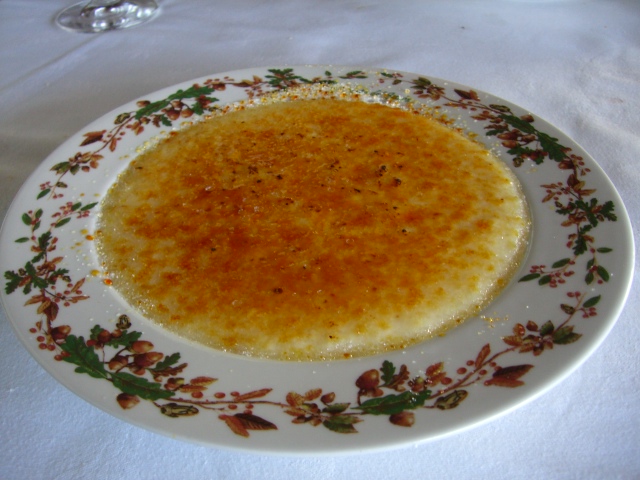
Postre was flan (very good, though not quite up to the gold standard of Isabel's) and arroz con leche. Having lost most of any sweet tooth I may have had as I got older, I never expected the dessert to be my favorite dish of many great ones, but it was. This was one of the two greatest rice puddings I have ever tasted, the other one being at Casa Gerardo in Prendes (the one I make at home following a recipe from Casa Gerardo is a close third). It is clearly made old-style, reducing the milk with not-so-very-much rice for 2-3 hours, stirring it almost constantly. It was beautiful, causing me to practically well up – a reaction I am not accustomed to having when it comes to desserts. The browned bits are part of the quemado (burmed) sugar crust:
In fact, I like the food and the natural setting here almost as much as Casa Juanín in Pendones, and there is really no higher praise than that.
Restaurante La Chabola
La Plaza, 15
La Plaza 33111 Teverga, Spain
(+34) 985 76 41 36
Showing posts with label Spain. Show all posts
Friday, March 30, 2018
Sunday, July 8, 2012
Restaurante Barbantes
I've become rather fond of Vigo in recent years. It's a somewhat quirky city in a stunning setting on the Ría de Vigo where ones euro buys one a bit more hotel than in other cities in Spain. And its close proximity to the Portuguese border gives it a bit of border town character. However, a great meal at a great price was proving a bit difficult to come by until last year, when I stumbled upon Restaurante Barbantes.
It's a family-run place that advertises comida casera, and they don't lie. The tireless dueño appears to be on hand at least 16 hours a day - I've never been there when he wasn't behind the counter, and the woman in the kitchen who does all the cooking is, I believe, his wife. Whoever she is, she sure knows what she's doing. I have had close to a dozen excellent meals here - it's difficult for me to get interested in eating anywhere else in Vigo, especially after a couple of samples of what else was out there. The 8,50€ menú (primero plato, segundo plato, dessert and beverage - and if that beverage is wine, they leave you a whole bottle) is a fantastic bargain, and is offered both at midday AND at night. Their borrego asado is a plate of meat too big for most normal people to finish (not me, of course), seasoned with some hot paprika, onions, a lot of bay leaf, and a hint of tomato. These albondigas (meatballs) are even tastier than they look.
And this fish parrillada de pescado was just beautiful: scrupulously fresh chunks of skate, sea bass and hake (part of the 8,50€ menú, no less).
Even desserts are above average here. And if you come by for breakfast, be sure to try a fresh-made empanadilla, a meat pie filled with 2 or 3 types of chopped pork product - the perfect way to start the day.
Restaurante Barbantes
Rua de Cuba, 3
36204 Vigo, Spain
(+34) 986 41 60 24
Thursday, July 5, 2012
Casa Gervasio revisited
It was my last night in Asturias, and since a visit to Oviedo is not complete without a cena at Casa Gervasio, no other destination was even an option. And now that I finally have a camera, it seems an update is warranted.
However, I’m delighted to report there is no update – everything is as wonderful as ever. Just a few pictures. The chorizos a la sidra here are among the best I’ve ever had, if not the best.
Stewed to juicy perfection in, of course, sidra, they are so tender the really do practically melt in your mouth.
These patatas fritas may look like ordinary potato chips, but they were just fried and are at once crispy and tender. And still warm.
A plate of jamón ibérico (aka, food of the gods) is always a great sidra accompaniment. This pic is not my best effort, but think cured ham more amazing than prosciutto could ever be.
There were some wonderful-looking tortillas espanolas at neighboring tables, but ours, while still good, came out slightly overcooked and in no way superseded memories of the tortilla at Bar Lito the night before. I wasn’t inspired to even attempt a photo of it, although I would have been happy to get one that good almost anywhere else.
Since I had no pictures of sidra being poured properly (pay attention, Tertulia, since you are dishonestly calling yourself a cider house), our friendly camarero gamely agreed to let me get a shot of him expertly pouring a culín. Here’s where it’s most obvious that I don’t quite have the hang of my camera yet: you’ll need to imagine a green bottle held horizontally above his head.
It appears that I’m just going to have to go back again soon for a better shot.
Casa Gervasio
c/de Fuente de la Plata, 68
La Argoñesa 33013 Oviedo, Spain
(+34) 985 23 42 55
La Venta del Jamón
On the old highway between Oviedo and Gijón, there's a restaurant that's been around for over 100 years - La Venta del Jamón. And there's a reason it's been around that long.
I think Asturian cooking can be summed up as simple, honest treatment of the best ingredients, and this establishment is one of the most exalted examples in the province. And there are a couple of things that they do better than anyone. First and foremost, their croquetas de jamón de bellota are the most amazing croquetas I have ever tasted (and my friend José Ángel - who has eaten a lot of croquetas in his time - agrees).
Their lightness and intensity of flavor are nothing short of mind-blowing.
There are traditional Asturian rice dishes that are almost never found in restaurants, but this place makes them, and superbly. The octopus (pulpo) one is perhaps the best-known, but I'm quite fond of their arroz con pitu de caleya (rice with free-range chicken).
Rather like a simple paella - it's cooked in a paella-type pan - but without the crusty bits. It's made with rice, broth, and shreds of poached free-range chicken. That's it. And the flavor is transcendent.
And their crema de arroz con leche requemado (rice pudding with a burned sugar crust) is almost as good as Casa Gerardo's:
Although not cheap, when one considers the high quality of ingredients and preparation, this place is a relative bargain.
La Venta del Jamón
Carretera Oviedo-Gijón, s/n
Pruvia de Arriba 33192 Llanera, Spain
(+34) 985 262 802
website
Monday, June 25, 2012
Bar Lito
Something incredible happened this evening: I was able to show my Asturian food guru (and longtime friend) José Angel a place in Oviedo with good food that he didn't already know. Of course, the only reason I knew about it was because of my friend Dave, the tuba player in the Orquesta del Principado de Asturias.
It's called Bar Lito, and it's one those old-fashioned places I love that looks like it hasn't changed in 70 years. It's a real bar - not a sidrería, so no sidra here - in the casco antiguo, with a comedor upstairs. And the dueña serves up some of the best traditional, home-style cooking in Oviedo. Dave loves the liver here. I have no doubt that it's excellent, but, although I'm a fairly adventurous eater, a plate of liver has never particularly appealed to me.
Tonight we had a really beautiful tortilla española:
(And note the old-style braided bread in the upper right.) Perfectly-cooked potatoes engulfed in palpably fresh eggs, not quite set in the center (which is just the way you want it).
This was followed by a plate of some of the best pollo al ajillo anywhere in Asturias.
Washed down with a bottle of really good house red wine, it was the perfect midnight snack. At lunch, they serve a 12€ menú. Although a little more expensive than other places around, the high quality makes it unquestionably worth the extra euro or two.
If you read Spanish, there's a lovely tribute to this place on a great Spanish restaurant blog I ran across this evening here.
Bar Restaurante Casa Lito
c/Altamirano, 11
33003 Oviedo, Spain
(+34) 985 22 02 25
Saturday, June 23, 2012
Regreso a Pendones
Today was the much-anticipated yearly pilgrimage to Casa Isabel (aka Casa Juanín) in Pendones (Caso), Asturias.
To use the old saying "the anticipation exceeded the actual event" would be... totally wrong. It was fabulous! If possible, even better than I remembered. And this time, I had a camera.
The flavor of today's sopa de pescado had even more dimension than usual.
The picture may not look like much, but lurking under the surface (orange from some paprika and, if I'm not mistaken, a tiny pinch of saffron) are shreds of fish and crab, as well as the visible clams.
Isabel surpassed herself with the fabes con jabalí. The famous large white haricot beans of Asturias in a rich stew of wild boar and bits of pimiento tasted better than ever.
Picadillo de venado was the usual fantastic, this time with the addition of two utterly fresh eggs from the hens in her back yard.
Think a sort of hash made from minced venison, paprika, and garlic. Accompanied by fried locally-grown potatoes, of course.
When we tried the cabrito, José Angel and I looked at each other and simultaneously expressed astonishment that it could be even more wonderful than usual. I was glad to know I wasn't just imagining it.
I don't know how Isabel does it - she's a sorceress in the kitchen. And I couldn't tell you what's in the sauce, aside from "nothing that doesn't belong there".
Although I'm a huge fan of the arroz con leche asturiano - and Isabel's is, of course, excellent - I can't seem to order anything but her flan for dessert there any more. It is truly the best I have ever tasted.
Casa Juanín (aka Casa Isabel)
Pendones, s/n
Pendones 33997 Caso, Spain
(+34) 985 61 37 25
Tino el Roxu (CLOSED)
Restaurante Sidrería Tino El Roxu is an excellent place to know about if you're in Gijón. The place has a good feel - usually just crowded enough to be convivial without being so packed as to make being served impossible. The sidra is good (and its eponymous red-haired proprietor has won many a competition for escanciadores), and the kitchen excellent: all the asturiano standards are good here, and at lunch there is an excellent 11€ menú.
Today's menú included pulpín con patatas, a hearty stew of diced potatoes and young octopus, seasoned with paprika. Lovely.
For segundo I chose imperador a la plancha, or a fried piece of red bream, aka alfonsino. Also nice, although cooked a tad too long.
This was accompanied by a bottle of much-better-than-decent house red wine. Dessert, the weakest part of the meal, was a perfectly ordinary flan. This all may not sound like much (although the pulpín con patatas was really great), but it was somehow more than the sum of its parts. I'm happy to go here almost any time.
Restaurante Sidrería Tino El Roxu
Avenida de la Costa, 30
33205 Gijón, Spain
(+34) 985 14 09 91
website
Monday, June 11, 2012
Boñar de León (CLOSED)
Edit: It is with great sadness I must report that my favorite restaurant in Madrid is not closed.
During a 9-hour layover in Madrid this week, en route to Berlin, I had time to go into town and have a nice, leisurely comida (midday meal, “midday” meaning 2 or even 3 p.m. in Spain – my kind of place!). When mulling over the possibilities the day before, it hadn’t taken me long to settle on the obvious choice: Boñar de León.
All told, this is probably my favorite restaurant in Madrid, although I readily admit it will not be to everyone’s taste. But for me, it hits all the marks, and hits ‘em hard: huge quantities of hearty, traditional, leonés cooking at rock-bottom prices. Although the rather dingy and forbidding bar up front does not exactly invite one to continue to the comedor in the back, don’t let it put you off. You will be amply rewarded with the best 10€ menú (the wonderful Spanish tradition of a first course, second course, dessert and beverage for one reasonable price) I can think of. A few years ago, I spent much of one summer in Madrid, and once I discovered this place, I ended up eating here at least twice a week – one week I remember eating lunch there every day.
The province of León is separated from Asturias by some spectacularly beautiful mountains, and the spirit of those mountains imbues the cooking. The key dish here is cocido leonés: heavier and more rustic than its madrileño counterpart (my love of hearty peasant food should be a given to my readers at this point), it is the star dish of their Monday menú. The term "stew" hardly does it justice. It is a one-dish meal of potatoes, chickpeas, carrot, cabbage, leeks, chicken, and at least four types of pork products, including (naturally) chorizo and morcilla (blood sausage). It’s all simmered together in a big pot, and the broth, with some fine noodles, is served as the first course. While they generally serve cocido completo only on Mondays, they have sopa de cocido (the broth with noodles) as part of the menú every day, and that’s what I began my meal with.
It may not look like much, but the flavor is wonderful. It’s rather like the most amazing chicken soup in the world. And yes, they left the tureen so I could take as much as I wanted - standard practice here.
Usually, I find the primero platos of Spanish menús more interesting than the segundos (and looking around at other tables, the pote gallego, a thick soup of turnip greens, white beans, potatoes, beef and chorizo, looked fabulous, as did the ensalada rusa, a sort of creamy potato salad with a bunch of other goodies in it). But I actually had a bit of trouble deciding on a second dish because too many of them sounded so good (and there are always at least 6 or 7 choices for each course here). In the end I settled on the caldereta de borrego, and it was the right choice:
A large chunk of lamb (mutton might be a better term, since borrego generally refers to meat from a sheep older than one year) that has been stewed with onions, a bit of tomato, some guindillas (hot peppers) and a lot of bay leaf, served with fried real potatoes. It was superb. Also vying for segundo choice were bonito a la riojana (tuna steak in a tomato-onion sauce) and lacón con patatas (more or less boiled ham and potatoes, but that does not begin to suggest its sublimity), always a great choice here.
When I asked for a chupito (a shot of postprandial digestif), this is what I was presented with:
That’s the kind of place this is. And my flight to Berlin was ever so much more pleasant than it might otherwise have been.
Real bargains that are worth enjoying can be tricky to find in Madrid. For my money, this is one of the best.
Boñar de León
c/Cruz Verde, 16
28004 Madrid, Spain
(metro: Noviciado)
Sunday, July 11, 2010
Casa Juanín
There is a restaurant in the mountains of eastern Asturias that I have been going to for at least 17 years. Taken there by my dear friend and Asturian food guru José Ángel, from the very first visit it took its place as my favorite restaurant in Spain, and, therefore, the world. It’s a very small, family-run place that I tried to keep a secret for years, to impart to only the truly worthy. But since there is now a detailed listing for it in the latest edition of the Guía Azul for Asturias, I guess word can safely be considered to be "out". It seems to be called Casa Isabel now, although it used to be called Casa Juanín, named for the dueño, her father, even though Isabel has always done all the cooking--at least since I've been going there.
I returned there today, and am delighted to see that nothing has changed—most notably, the quality—in 17 years. It’s in a tiny pueblo called Pendones--a handful of houses perched up on a mountainside above AS-117 on the way to the Puerto de Tarna. The restaurant is nothing more than two small rooms that comprise (along with the third small room, the kitchen) the ground floor of their house. Everything is homemade, with what are palpably local ingredients. It’s heavy, mountain fare, so perhaps best enjoyed in cooler weather… but I’ve got to grab my visits when I can! The offerings are always the same, plus or minus a dish or two, but you can generally count on: sopa de pescado (fish soup), fabes con jabalí (the oversized white haricot beans used in fabada, stewed with wild boar), picadillo de venado (sauté of minced venison seasoned with paprika and garlic), callos (tripe), and cabrito (stewed kid goat). As great as the cabrito is, somehow that venison picadillo is even more amazing. Sometimes there’s pitu de caleya (stewed free-range chicken). There’s always arroz con leche for dessert, and Isabel makes the best flan I have ever had. Because every bit of it is local and real and prepared by an expert, the food all has more flavor than one would think possible.
Pendones can be a bit tricky to find—it’s not even on a lot of maps. Heading southeast on AS-117, head past Campo de Caso another 5 kilometers or so to La Foz. Keep going another kilometer or two and keep a sharp lookout for small sign pointing you up the mountainside to the left. And because of the tiny size of the restaurant, definitely call ahead for a reservation.
Casa Juanín (aka Casa Isabel)
Pendones, s/n
Pendones 33997 Caso, Spain
(+34) 985 61 37 25
Saturday, July 10, 2010
El Bulevar de la Sidra
Edited January 2018: Sadly, a recent trip to Oviedo revealed that Sidrería Ferroviario has changed owners, menu, and concept and is no longer recommendable... at all. Sidrería Zandarín has been closed for some time. The only good kitchen left on the street that is not exorbitantly expensive is Sidrería La Cabana, c/Gascona, 19.
The Calle Gascona in Oviedo has traditionally been home to a bunch of sidrerías over the years, but it’s only been in the last decade or so that someone had the bright idea of marketing the two quaint blocks that comprise it as “El Bulevar de la Sidra”. There's even an official website, run by the “Asociación de Hosteleros de la Calle Gascona”. By no means all of the sidrerías on the street are members, and the ones that are seem to me to be more notable for their desire for self-promotion and a certain mediocrity of fare rather than real quality.
I readily admit to a certain perverseness when it comes to these things, so, predictably enough, my two favorites on the street are the oldest and the newest of the sidrerías. Starting with the newest (though it didn't last very long - it's now closed), Sidrería Zandarín (named for a pueblo near Cangas del Narcea) has been open for business just over nine months and has already distinguished itself as one of the better cocinas on the street. I chose it randomly—on the basis of its appealing menú del día, coupled with its appealing price of €10 —when I arrived in Oviedo Sunday afternoon and needed to find a place to eat lunch quickly before everything closed. One of the primero platos was fabada asturiana… I hadn’t had fabada in over a year, and it was a cool afternoon (most important), so I went for it. And to my great surprise, it was excellent. REALLY excellent. I have been served some shockingly mediocre fabadas in the past, in places that should have been serving something much better than goop that could have come from a can, so for years I have confined my fabada-eating to places like La Máquina in Lugones and Casa Gerardo. I was, admittedly, flying blind. But luck was with me: tender, almost perfectly-cooked fabes (beans), and embutidos (chorizo, morcilla, lacon, and tocino) worthy of the very best places. It was good enough to remind me what a great dish it really is. This was followed by an entrecot de buey that actually tasted like ox and not just generic cattle. I went back the next evening for some of the best pollo al ajillo (bone-in chunks of chicken fried with garlic) I’ve ever had.
Sidrería Ferroviario has been around for almost 6 decades, making it about the oldest establishment on the street. And it’s holding up beautifully… no flash, no glitz—just good, reasonably-priced food and, as one review I read said, “buena sidra, bien escanciada” (good sidra, well-poured). After spending time in lesser sidrerías--I even got to watch my friend José Ángel school the waiter in the proper way to escanciar la sídra the other day--it’s easy to forget what a difference this can make. On my most recent visit, they were pouring Peñón sidra (for my tastes, an excellent maker), and these guys know what they’re doing… officially: Ferroviario is well-known for having on its staff winners of international concursos de escanciadores (sidra-pouring competitions). And with sidra, it really does make a difference. Try it for yourself sometime: hit a few of the sidrerías in the c/Gascona, ending with Ferroviario. See if it doesn’t actually taste the best. They also boast an excellent, traditional Asturian kitchen with a great €9 menú del día. And this is one of the few places around you can still get traditional jamón asado. It’s yet another Spanish dish with jamón in the name, but it’s unlike any other: slices of a roast ham, but it is the ham BEFORE being cured. It’s not pink, it’s not salty—just a spectacularly moist, delicious pork roast. It may exist outside of Asturias, but I have never encountered it anywhere else. I had fidegüa there today: a stew of seafood with thick noodles. You NEVER see that on menus any more. And when I ordered arroz con leche for dessert (one of the glories of Asturian cooking—there’s a great recipe for it here), I was asked if I wanted it quemado (with its traditional sugar crust burned on top, like crême brulée). I almost fell off my chair… such a nicety is rarely offered at this price point.
Sidrería Zandarín (closed permanently)
c/Gascona, 22
33001 Oviedo, Spain
(+34) 985 22 77 80
Sidrería Ferroviario (no longer recommendable)
c/Gascona, 5
33001 Oviedo, Spain
(+34) 985 22 52 15
website
Friday, July 9, 2010
Tierra Astur
If there is one restaurant that sums up what is for me the essence of Asturias and its food and drink, it is Tierra Astur in Colloto, on the outskirts of Oviedo. If you’re anywhere nearby, grab as many people as you can and GO, and be prepared for a hedonistic binge of consumption. It’s one hell of a party!
It is, first and foremost, a sidrería (pictures from their website):

The design of the Colloto location—converted from the old Águila Negra beer factory—is fantastic, and the “wall of water” is an ingenious modern take on a traditional way keeping the sidra at the proper temperature, which I first experienced at an outdoor chigre in Soto de Agues, tucked next to a puente de piedra with the bottles chilling in the stream.

Here one can enjoy sidra escanciado, or “de espicha” (from the tap):

You won’t find sidra de espicha just anywhere, so I suggest trying it here. It also has the advantage of being “all-you-can-drink” for one quite modest price, as opposed to paying by the bottle.
The menu is huge, and everything is listed, charmingly, in bable asturiano and castellano. Stick as closely as you can to the traditional parrilla fare—it’s what they do best. For starters, they have a wide selection Asturian embutidos (cured meats of various kinds)… try everything. As much as I love it, this probably isn’t the place to get jamón ibérico. It’s decent quality—not the best—but sliced by machine and not by hand. The same weight goes farther that way, but the texture, and therefore the flavor, isn’t right. But with all the other great cured meats and sausages you shouldn’t miss it.
Hopefully you’ve arrived with enough people to warrant ordering the parrillada, a veritable avalanche of food that easily feeds 5-6, and a bargain at €38: chorizu criollu (light-colored pork sausage), chorizu roju (red, paprika chorizo), morciella fresca (blood sausage), pitu (chicken), costiella de gochu (pork ribs), costiella de xata (beef ribs), llacón (pork hock), churrascu (cross-cut beef rib), entrecó de carne roxa (beef entrecote), paletilla de corderu (lamb), pimientos (roasted red peppers) and fried potatoes. They do a good chuletón de güe (ox chop) here, too. It may not be up to the high quality of Nozana, or even El Quesu in nearby Bobes (Siero), but it's better than adequate. The items from kitchen (as opposed to the grill) tend not to be nearly as good. There’s an incredible selection of Asturian cheeses for postre (once again, don’t bother with the kitchen dessert items).
There are three locations at this point, and for my money the Colloto one is by far the best (if you go, you may be lucky enough to be waited on by Cristina, who will give you some cheeky auténtico asturiano banter while doing a great job). There’s also one in El Bulevar de la Sidra (calle Gascona) in Oviedo, and a newly-opened location on the Playa de la Poniente in Gijón—say hello to my friend Saulo if you hit that one!
Tierra Astur
Antigua Fábrica del Águila Negra
Colloto 33010 Oviedo, Spain
(+34) 985 79 12 28
website
Wednesday, July 7, 2010
Mesón de Nozana
The parrilla of central Asturias is, predictably, probably my favorite genre of restaurant in the world. The most traditional ones are open, airy structures, the nerve-centers of which are big, wood-burning stone hearths where the meats are grilled in plain view of anyone who cares to watch.
One of the very best of these is Mesón de Nozana in Viella, just a few kilometers east of Oviedo.
Their parrillada is a mountain of grilled meats that easily feeds 3-4 people: beef ribs, pork ribs, sirloin, lacón (like what Americans think of as ham), grilled chicken with lemon, chorizo criollo (white-pink seasoned pork sausage), and chorizo rojo (semi-cured paprika pork sausage).
At 28€, an unbelievable bargain, especially considering the high quality of the meats. They also have a full selection of appetizers, salads, and other basic Asturian dishes, plus a a wine list that covers all the Spanish bases (Ramón Bilbao is an especially good choice with all that meat), and, of course, sidra.
Mesón de Nozana
c/Iglesia, 2
Viella 33429 Siero, Spain
(+34) 985 26 05 36
a bare-bones website
Casa Gervasio
Ah, sidra! You can't go to Asturias without trying sidra, a kind of hard apple cider, and Asturias is almost the only place you can drink it. The cider is fermented for about six months, at which point it should be drunk almost immediately, and it doesn't travel well. It's not sweet, and doesn't taste particularly strongly of apples--it's more reminiscent of new wine than anything. And it can only be had in a certain kind of place--sidra is almost its own subculture, and has its rules. Each green glass bottle has about six small servings' worth. The cider must be aerated for it to be at its best, so for each serving, the escanciador must echar un culín: the bottle must be held above the head so that it can be poured into a large, wide-mouth glass tumbler held below the waist so it breaks against the side of the glass--just enough for one big gulp (folklore has it that if globules present in the bottled sidra aren't broken up this way, they can make you nauseous). When drinking, leave just a bit in the glass, and pour out the dregs (into the troughs built into the bar for this purpose, or a wooden bucket, or the floor, which will probably have some sawdust on it). Because this libation is fairly messy, it's generally not served in fancy restaurants, but in sidrerías only (other key words to look for on signs if thirsty for sidra: chigre and llagar).
Casa Gervasio is a real old-fashioned llagar--it looks like it hasn't changed in 60 years. The decor is clean and simple, and somehow you just know you're going to get something special there. And indeed you do--sidra, of course, and some of the best, simple, Asturian cooking you'll find in Oviedo. Word is they make the best fritos de pixín around here, and it's difficult to imagine better: lightly-battered chunks of monkfish perfectly fried. They make a stupendously good chorizo a la sidra (a soft, Asturian-style chorizo stewed in--what else?--sidra), and the freshly-made tortilla española (the potato-egg cake kind of tortilla, almost like a frittata) is almost a revelation. And don't miss the homemade potato chips... look around and you'll notice a plate of them on almost every table, for good reason. Someone in that kitchen REALLY knows their way around puff pastry (hojaldre) and pastry cream... the milhojas de crema con natas is perhaps the most exquisitely delicate dessert I've had in years (even better than the tarta de hojaldre at Restaurante Panduku, just outside of Oviedo in Granda, for years my gold standard for such desserts), and the canutillos--same ingredients, different shape--are equally good. Ask what they have that day--at any one time they prepare only a portion of the large menu. You can rest assured anything you order will be fresh and expertly-prepared.
Casa Gervasio
c/de Fuente de la Plata, 68
La Argoñesa 33013 Oviedo, Spain
(+34) 985 23 42 55
Wednesday, March 31, 2010
La Llar de L'all i Oli
Inspired by a couple of opera colleagues who are in Barcelona right now, I thought I'd add a little review of what is easily my favorite restaurant in or near Barcelona--indeed the only one I tried that I would take any trouble to return to--La Llar de L'all i Oli in Badalona.
In its way, this place is a monument to good ingredients. The cooking is simple and, from what little I know about Catalan cooking, utterly traditional. The obvious care that goes into the preparation results in food that is much greater than the sum of its parts. Standard on every table are a slice or two of toasted bread, some ripe tomatoes (probably from a nearby--or on site--garden) and a cruet of olive oil to make one of the most inspired snacks on earth, pa amb tomàquet. This is accompanied by a little pot of all i oli (garlic mayonnaise, made with garlic and olive oil ONLY--palpably homemade, as is everything here, and stupendous... it is so light it's almost fluffy, if you can imagine that). I began my first meal with a sopa caselona, which turned out to be a rich chicken broth with fideus (noodles). I don't know how they did it, but it was the most delicious soup of that sort I think I've ever had. This was followed by a paletilla de Huesca, which was a whole leg of baby lamb that had been coated with chopped fresh herbs and finely diced vegetables and baked in the oven. It's difficult not to keep harping on the high quality and freshness of the ingredients--the accompanying potatoes HAD to be from someone's garden there... simply done, and unbelievably delicious. I couldn't resist trying crema catalana in such a place and it was, predictably, the best I have ever tried.
I went back the very next night and had another equally wonderful meal, this time beginning with a simple grilled chorizo, but naturally of the highest quality, accompanied by more of those marvelous potatoes. Somehow, this truly transcended the sum of its parts, don't ask me how. This was followed by galtes a la brasa, or grilled pork cheeks. The only adjective for this is "wonderful"...I'm at a loss to describe them--they just need to be experienced. The house wine is, fortunately, just fine (and often the only sensible option for the perpetually solo diner like myself).
Badalona is an easy 15-minute train ride (on the number 1 RENFE cercanía line) from the center of Barcelona. As you exit the front of the Badalona train station, turn left and go 4 or 5 blocks until you reach carrer Conquesta, and turn right. The restaurant is about 3 blocks up, on the left. Closed Sunday nights and Mondays, it's a good idea to call ahead and reserve, especially on the weekends: 93 383 53 07.
(Ed. Oct. 2013: The only reason I even knew about this restaurant at all was because of Jim Leff, from the old Chowhound days. Apparently, this very blog post inspired him to revisit La Llar de L'all i Oli last month specifically to try the galtes a la brasa. There is a nice picture of them included in his post about it, and some pics of pa amb tomàquet and the signature pot of all i oli in an earlier photo essay of his. I love the "coming full circle" aspect of this.)
La Llar de L'all i Oli
c/Conquesta, 87 - Badalona 08912
Spain
(+34) 93 383 53 07
Subscribe to:
Posts (Atom)